
Up to 19 gpg. That is the water hardness recorded in parts of Los Altos Hills and Cupertino when local groundwater enters the supply mix. The national threshold for “very hard” water is 10.5 gpg. At 19 gpg, a standard tank water heater loses roughly half its usable lifespan without proper maintenance, dropping from 12–15 years to 5–7.
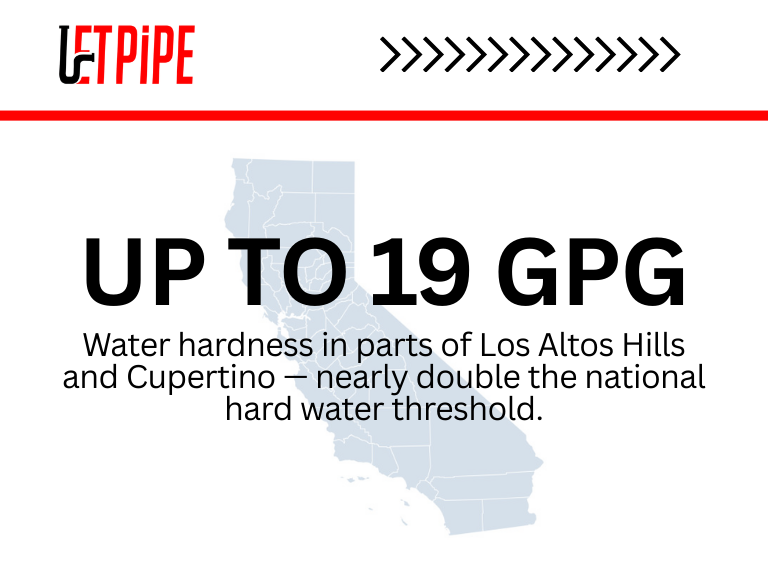
In Cupertino and Los Altos Hills, this is not a hypothetical. The Los Altos Suburban water system blends local groundwater (up to 19 gpg) with Valley Water surface supply (6–7 gpg). Depending on your street, the season, and current drought conditions, the water coming out of your tap can fall anywhere in that range — sometimes in the same month.
This article explains the mechanism, the local data, how to recognize the warning signs, and what your options are.
What Happens Inside the Tank
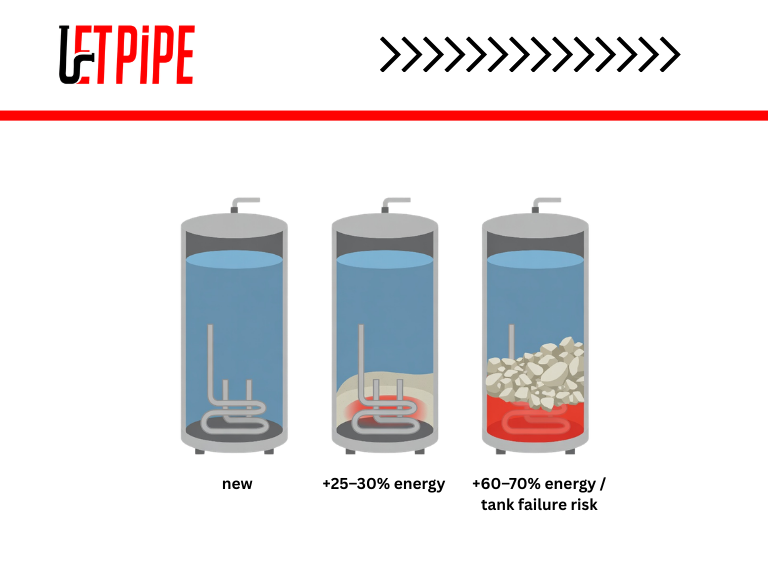
When hard water is heated, dissolved calcium and magnesium minerals precipitate out of solution and settle as a solid layer — scale — on the tank floor and on the heating element. Scale is a poor conductor of heat.
A 1/8-inch layer of scale increases energy consumption by 25–30%. At 1/2 inch, energy use rises by 60–70% and the risk of element failure or tank rupture increases significantly. In high-hardness conditions — 15–19 gpg — scale at this thickness can form in under three years without a maintenance flush.
The result is a heater that runs longer cycles, heats unevenly, and reaches mechanical failure years ahead of its rated lifespan. The damage is cumulative and largely invisible until symptoms appear.
The Local Factor: Why Cupertino and Los Altos Hills Are Higher Risk
Most water hardness guides use static averages. The reality in this area is more complicated and more damaging.
The Los Altos Suburban water system draws from two sources: local groundwater wells (ranging from 89 to 470 mg/L, or roughly 5–27 gpg depending on the well) and treated surface water from Valley Water (92–122 mg/L, approximately 5–7 gpg). These sources are blended, but the ratio shifts based on demand, precipitation, and aquifer levels.
During dry periods, groundwater makes up a larger share of the supply mix. That means a water heater that was operating in moderately hard conditions in winter may be running in very hard conditions by late summer without any visible change at the tap.
| Water Source | Hardness Range | GPG Equiv. | Classification |
|---|---|---|---|
| Local Groundwater | 89–470 mg/L | 5–27 gpg | Moderate to Very Hard |
| Valley Water (surface) | 92–122 mg/L | 5–7 gpg | Moderately Hard |
| Your Tap (mixed supply) | 120–320 mg/L | 7–19 gpg | Hard to Very Hard |
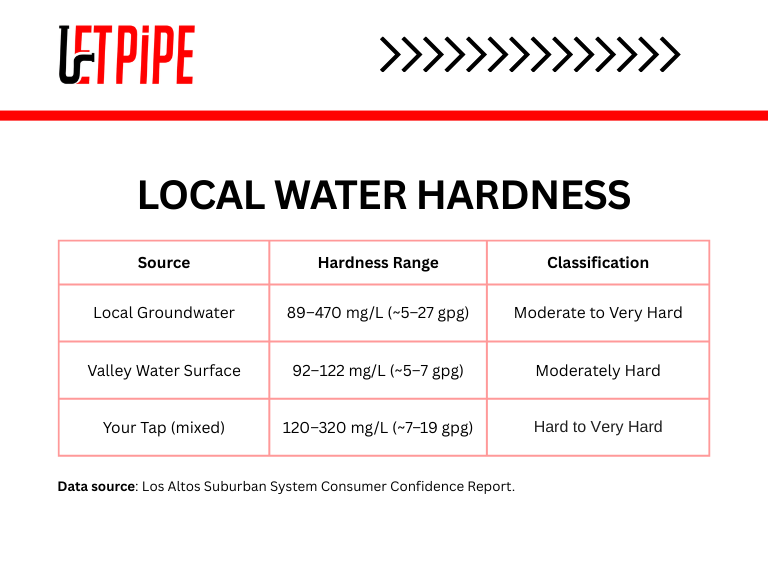
Source: Los Altos Suburban System Consumer Confidence Report
The practical consequence: there is no single hardness number for your address. The only reliable way to know your current level is a water test. Without one, you are maintaining your water heater based on guesswork.
Warning Signs Your Water Heater Is Already Affected
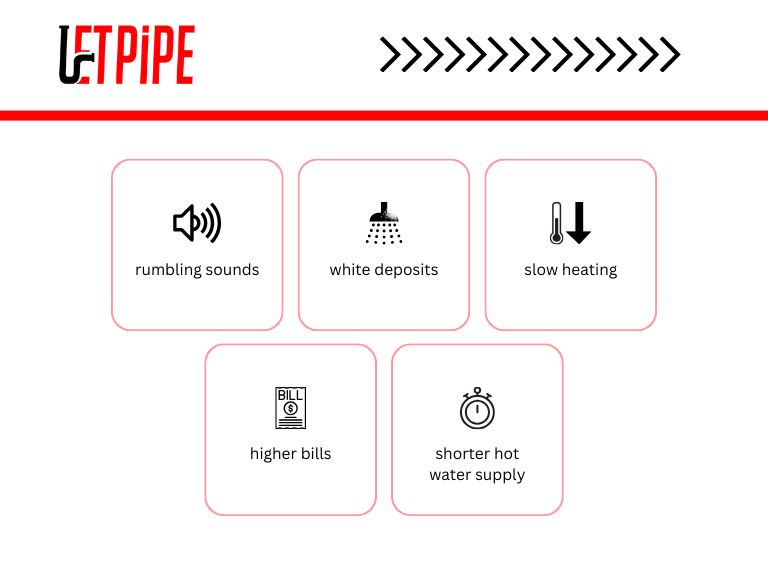
Scale buildup does not announce itself. By the time these symptoms appear, the process has typically been underway for one to two years:
- Rumbling or popping sounds during the heating cycle — loose scale shifting on the tank floor as water boils around it
- Hot water runs out faster than it used to — reduced effective tank capacity due to sediment displacement
- White or gray mineral deposits on faucet aerators, showerheads, and kettle interiors
- Gas or electricity bills rising without a change in usage — the heater is running longer to compensate for scale insulation
- Water takes noticeably longer to reach temperature — both at the heater and at the fixture
Each of these symptoms indicates active scale accumulation. Continued operation without service accelerates wear on the heating element and tank lining. The heater does not recover on its own.
What You Can Do: Three Options, by Budget and Tank Age
There is no single correct answer. The right approach depends on your tank’s age, current condition, and how far you want to go in protecting the rest of your plumbing system.
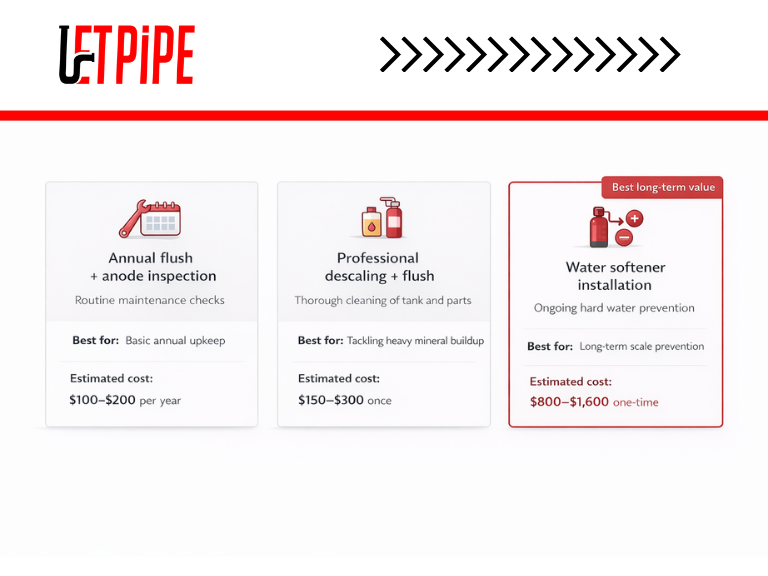
| Option | Best For | Est. Cost | Value |
|---|---|---|---|
| Annual Flush and Anode Rod Inspection | Best for tanks under 5 years old with no symptoms yet | $150–$250 | Basic |
| Professional Descaling and Flush | Best for tanks 5–8 years old with visible symptoms | $200–$350 | Intermediate |
| Water Softener Installation | Best for long-term protection of all plumbing and appliances | $500–$2,500 | Best Long-Term Value |
Option 1 — Annual Flush + Anode Rod Inspection. Flushing removes loose sediment before it hardens into scale. Combined with inspecting the sacrificial anode rod (which slows corrosion), this is the minimum effective maintenance for a newer tank. It does not reverse existing scale, but it slows future accumulation. Estimated cost: $150–$250.
Option 2 — Professional Descaling + Flush. For tanks showing symptoms — sound changes, longer heating times, reduced capacity — a descaling service uses a mild acid solution to dissolve existing mineral deposits before flushing. This can extend the functional lifespan of a mid-age tank by two to four years. Estimated cost: $200–$350.
Option 3 — Water Softener Installation. A whole-house softener addresses the problem at the source. By removing calcium and magnesium before the water enters your plumbing, it eliminates scale formation in the tank, on heating elements, inside pipes, and in appliances such as dishwashers and washing machines. Initial cost is higher ($500–$2,500 depending on system capacity), but the savings in energy costs and extended appliance lifespans typically recover that investment within two to three years in high-hardness areas like Cupertino and Los Altos Hills.
Not Sure How Hard Your Water Is? That’s the Starting Point
Most homeowners in Cupertino and Los Altos Hills don’t know their exact water hardness, and that’s exactly the problem. Without a test, any maintenance decision is a guess.
JetPipe Plumbing offers free water hardness testing on every service visit. Our licensed plumbers serve Cupertino, Los Altos Hills, and the surrounding South Bay and perform a flush, descaling, anode rod replacement, or water softener installation on the same call.
Call (650) 495-4570 to schedule.