
Beneath the streets of Palo Alto runs 230 miles of water pipe. Most of it was installed between the 1940s and 1970s. The city is replacing it — about three miles per year, at a cost of $3 million annually. Menlo Park is doing the same, swapping out asbestos cement mains that have been in the ground since 1945.
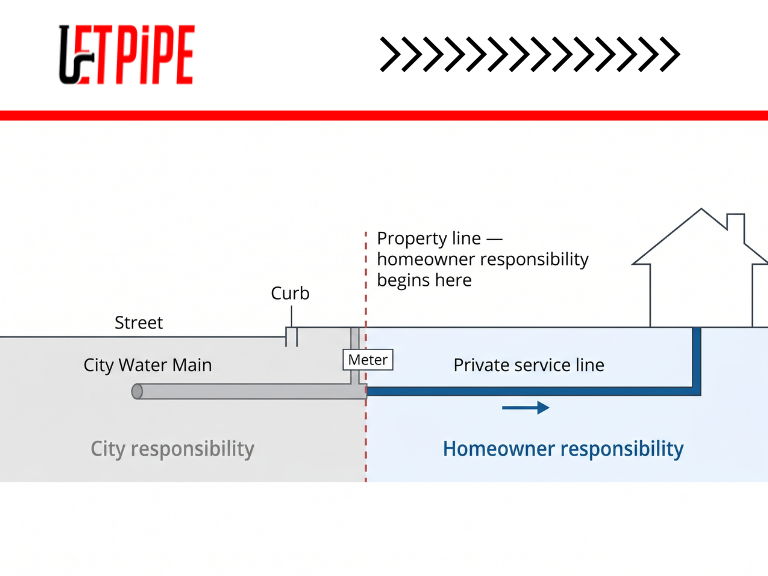
The city handles what’s under the street. What runs from the city’s water main to your front door is a different matter. That stretch of pipe — called a private service line — is your responsibility. If it fails, the repair bill is yours.
In pre-1980 homes throughout Palo Alto and Menlo Park, many of these private lines have never been replaced. Some are galvanized steel. Some are the same asbestos cement the city is pulling out of the ground right now. And most homeowners have no idea what’s buried under their yard.
This article explains what’s likely in the ground based on your home’s age, how to recognize the warning signs before a failure, and what to expect when it’s time to act.

Most homeowners assume that water infrastructure is the city’s problem. The reality is more specific.
The city water main runs beneath the street and is fully maintained by the utility. From that main, a private service line branches off and travels underground across the sidewalk, through your front yard, and into your home. That line — from the city’s connection point to your water meter and beyond — belongs to you.
In Palo Alto, the division is at the property line or the meter, depending on the configuration. Anything on the house side is the homeowner’s responsibility: repair costs, replacement costs, permit fees, and yard restoration.
Menlo Park follows the same structure. When Cal Water replaced a corroded main on Middlefield Road in 2022 — a pipe originally installed in 1945 — the upgrade covered the city’s infrastructure. Private service lines connecting homes to that main were outside the scope of the project.
This means two things. First, a city infrastructure upgrade near your home does not include your private line. Second, if your line fails, no one is coming to fix it unless you call.
The material of your private service line depends heavily on when your home was built. Here’s what was standard in each era across Palo Alto and Menlo Park:
| Era | Material | Expected Lifespan | Risk Level |
| Pre-1930s | Cast iron | 75–100 yrs | High — at or past end of life |
| 1940s–1970s | Galvanized steel, asbestos cement | 40–70 yrs | Very High — likely past end of life |
| 1970s–1990s | Copper, early PVC | 50–70 yrs | Moderate — inspect if symptoms present |
| 2000s+ | HDPE, modern PVC | 50–100 yrs | Low |
The 138 miles of asbestos cement pipe under Palo Alto’s streets — most of it installed in the same 1940–1970 window — gives a clear picture of what private service lines from the same period look like. The materials aged together. The risks are similar.
If your home was built before 1980 and the water line has never been replaced, it is at or past its expected service life.
Warning Signs Your Service Line Is Failing
Most private water line failures don’t happen without warning. These are the signs to watch for:
- Rust-colored or brown water from the cold tap. Discoloration from the hot side points to the water heater. From the cold side, it points to the supply line. Internal corrosion in galvanized pipe is the most common cause in pre-1980 homes.
- Low water pressure that has gradually worsened. Mineral buildup inside aging galvanized lines narrows the interior over time. A pipe that was 3/4-inch in diameter can corrode down to 1/4-inch of usable flow.
- Wet or soggy patches in the yard during dry weather. Water migrating upward from a buried leak is the most reliable outdoor indicator of a failing line.
- A water bill that increased without any change in usage. A hidden underground leak can waste hundreds of gallons per day without visible evidence inside the home.
- Metallic taste or smell in tap water. When internal pipe corrosion reaches the water supply, it’s no longer a maintenance question — it’s a water quality issue.
| Meter Test Record your water meter reading. Do not use any water in the home for two hours. Check the meter again. If the number changed, there is an active leak somewhere in the system. This test takes ten minutes and costs nothing. |
Rusty water, low pressure, or a water bill that keeps climbing?
We’ll check your main line and replace it if it’s failing.
Why Bay Area Lines Age Faster
Local Factors
Water lines in Palo Alto and Menlo Park face conditions that accelerate deterioration beyond national averages.
Expansive clay soil.
Santa Clara Valley sits on Vertisol clay that swells significantly when wet and contracts when dry. This seasonal movement creates lateral pressure on buried pipes and causes stress fractures at joints — the same mechanism that damages sewer laterals in pre-1980 homes. Every wet season adds incremental stress.
Seismic activity.
The Hayward, Calaveras, and San Andreas faults all run through or near the Peninsula. Small tremors — many below the threshold of human perception — create micro-displacements at pipe joints and fittings. These accumulate. A line that might last 60 years in a seismically stable region can fail at 40 here.
Hard water.
The Los Altos Suburban water system, which serves parts of this area, delivers water with hardness ranging from 7 to 19 grains per gallon depending on the mix of groundwater and imported surface water. At the high end, mineral scale builds up inside galvanized and older metal pipes, restricting flow and accelerating internal corrosion.
Tree root intrusion.
Mature trees along Palo Alto and Menlo Park streets — oak, eucalyptus, willow — have root systems that extend well beyond their canopy. Roots follow moisture and can penetrate pipe joints from the outside, accelerating cracking and blockage.
Repair or Replace: How to Decide
Not every issue requires a full replacement. Here’s how to think through the options:
When a spot repair makes sense
- The line is less than 20 years old.
- The damage is isolated — a single cracked joint or pinhole leak, not a pattern.
- The pipe material is copper or HDPE in otherwise good condition.
- No history of repeat repairs on the same line.
When full replacement makes sense
- The pipe is galvanized steel or asbestos cement and more than 40 years old.
- You’ve had two or more repairs in the past five years.
- Water discoloration persists after flushing and can’t be traced to the heater.
- You’re adding an ADU or planning significant remodeling — now is the time.
- You’re preparing to sell the home.
| Service | Estimated Cost |
| Spot repair — single leak or joint | $175 – $550 |
| Partial replacement — damaged section | $1,500 – $3,500 |
| Full private service line replacement | $3,000 – $8,000 |
Costs vary based on line length, soil conditions, depth, and permit requirements. Permit fees in Palo Alto and Menlo Park are additional.
A single full replacement typically costs less than three separate repair calls over five years on a line that has already started failing. If the pipe is past its lifespan, repairs extend the problem — they don’t solve it.
What the Replacement Process Looks Like
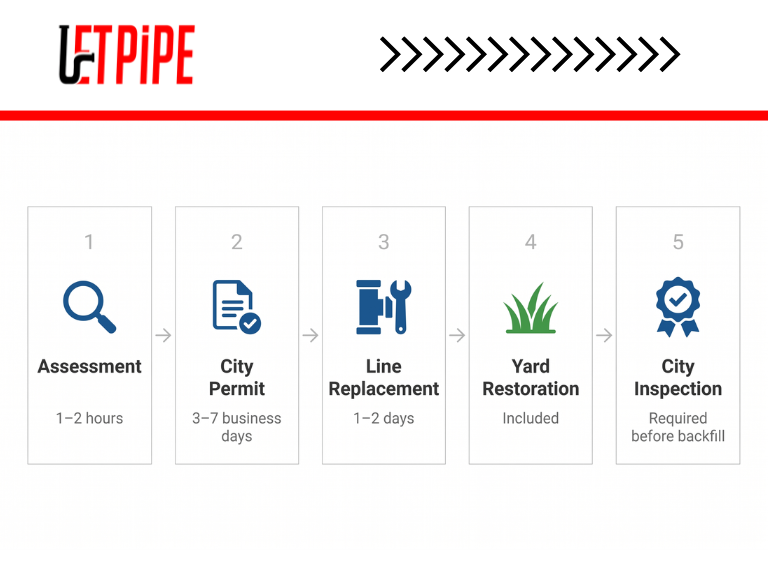
Many homeowners put off water line work because they expect a major disruption. The process is more predictable than most assume.
- Assessment and quote: 1–2 hours on-site. A licensed plumber inspects the accessible portions of the line, reviews the symptoms, and provides a written estimate before any work begins.
- City permit: Required for any work on a private water line in Palo Alto and Menlo Park. Permit processing typically takes 3–7 business days. All work must comply with the city’s Building Division requirements.
- Line replacement: For a standard residential service line, excavation and installation typically take one to two working days. Existing landscaping is marked before work begins.
- Yard restoration: Trench backfill, compaction, and basic surface restoration are completed as part of the job. Full lawn regrowth takes several weeks.
- City inspection: A final inspection by city staff is required before the trench is permanently closed. This step cannot be skipped.
If your home was built before 1980 and the water line has never been replaced, an assessment takes a few hours and answers the question definitively. You’ll know what’s in the ground, what condition it’s in, and whether anything needs to happen now.
JetPipe Plumbing handles private water line assessment, repair, and full replacement for homes in Palo Alto, Menlo Park, and surrounding Peninsula cities. All work is permitted through the city’s Building Division and inspected before completion.
Older Palo Alto home still on its original main water line?