
Most Bay Area homeowners think about their water line twice: when the house was built and when something goes wrong. Everything in between is invisible. The pipe running underground from the street meter to the house, buried a few feet down, is doing its job without any attention.
But the soil around that pipe is not static. In Santa Clara County, much of the ground is vertisol clay – the same rich, dark soil that made the Santa Clara Valley productive farmland for generations. Vertisol clay expands when wet and contracts when dry, sometimes significantly. Over years of California drought cycles, that movement accumulates. And when the rains return, the soil does not just quietly rehydrate. It shifts, swells, and applies new pressure to everything buried in it.
This article explains what that process actually does to a residential water line and what homeowners in Sunnyvale, Mountain View, Cupertino, San Jose, and surrounding communities should watch for during dry years and in the seasons that follow.
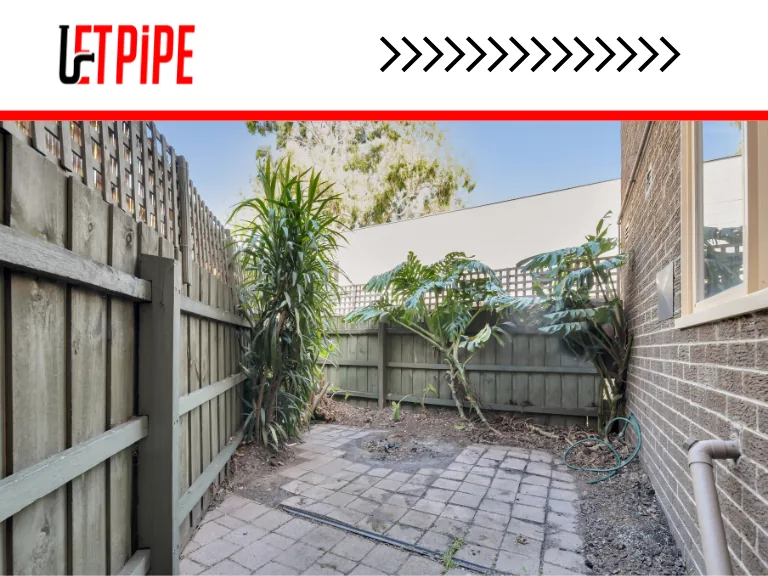
The Ground Beneath Your Yard Is Moving
It is easy to think of soil as something fixed and stable. It is not, especially in Northern California.
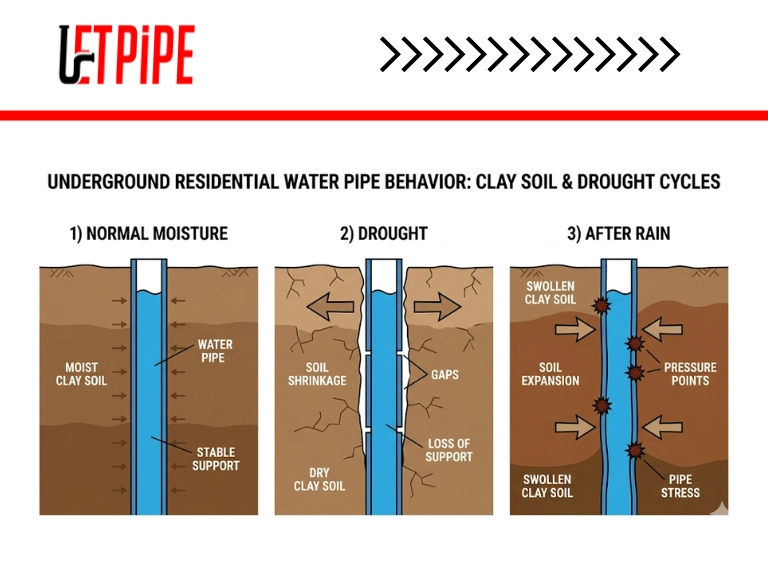
Vertisol clay, found throughout the Santa Clara Valley floor and in parts of San Mateo County, absorbs moisture and swells during wet months. In summer and during drought years, it dries out and contracts. This shrink-swell cycle is a normal part of the regional geology, but it is also one of the most damaging forces acting on underground plumbing.
During a prolonged drought, the contraction goes deeper and lasts longer than in a typical dry season. Soil that would normally recover moisture in October or November stays dry well into winter or beyond. As it shrinks, it can pull away from buried pipes, leaving sections of the line unsupported. Pipes that were once surrounded by packed, stable soil are now resting in voids.
Santa Clara County experienced drought emergencies in 2014 through 2017 and again in 2021 through early 2023. Valley Water declared a water shortage emergency in June 2021 and called for a 15 percent reduction in water use. During those years, soil moisture in the region dropped significantly and stayed low for extended periods.
What Prolonged Drought Does to a Water Line
Soil support disappears
A buried water line depends on the surrounding soil for structural support. When clay dries and contracts around a pipe, the pipe loses that support along unsupported spans. Under the weight of soil above and the internal pressure of water flowing through it, an unsupported pipe can begin to sag. Small sags become joints under stress. Stressed joints develop small separations. Small separations become leaks.
This process happens slowly over months or years, which is why homeowners rarely connect a slow pressure drop or a wet spot in the yard to the drought years that preceded it.
Soil shrinkage creates lateral movement
Shrinking clay does not just move downward. It also moves laterally, pulling in all directions as it contracts. A pipe that runs through a section of clay undergoing differential shrinkage where one portion of the soil dries faster than another, as happens near trees, under pavement, or along a foundation, can be pulled slightly out of alignment. A joint that shifts even a fraction of an inch loses some of its seal integrity.
Older pipes are far more vulnerable to this. A copper main water line installed in the 1960s has decades of joint history. A galvanized steel line from the same era may already have internal corrosion narrowing its walls. Both materials become less tolerant of ground movement as they age.
Hard water compounds the problem
Bay Area water is consistently hard – Valley Water reports hardness levels across Santa Clara County ranging from roughly 7 to 19 grains per gallon depending on the source and season. In galvanized steel pipes, that mineral content accelerates the deterioration of the zinc coating. Once the zinc is gone, the underlying steel oxidizes. Rust accumulates on the interior walls, narrowing the effective diameter of the pipe and creating rough surfaces where scale deposits build. A pipe already weakened by internal corrosion tolerates ground movement significantly less well than one in good condition.
Copper is more resistant to the effects of Bay Area hard water, which is one reason copper is the preferred material for water line replacement work in this region.
Why the Return of Rain Often Causes More Damage
This is the part most homeowners do not expect.
After a multi-year drought, the soil has contracted, shifted, and in some cases cracked. Pipes running through that soil have been living under different stress than they were designed for. Joints have opened slightly. The pipe may have moved.
Then the rains return.
California ended its 2021 to 2023 drought emergency in large part due to the atmospheric river storms of winter 2023 – some of the most intense rainfall the region had seen in decades. Santa Clara County went from drought conditions to flooding within a matter of weeks.
Vertisol clay that has been dry for two years does not rehydrate gradually. It absorbs water, and it swells. Rapidly. Soil that contracts away from pipes pushes back against them from new angles. Sections of pipe that had settled into unsupported positions are now under upward and lateral pressure from re-expanding clay. Joints that opened under drought conditions are now being pushed in the opposite direction.
This is when pipes fail. Not during the quiet dry years, but in the wet months that follow them. A joint that was stressed by soil shrinkage is then stressed again by soil expansion, and that second stress event is often what finally causes a visible failure.
Which Pipe Materials Are Most at Risk
Not all water lines respond to soil movement the same way. Material matters significantly.
Galvanized steel
Galvanized steel main water lines were standard in Bay Area homes built before approximately 1960. They are the most vulnerable category. Internal corrosion from hard water has typically reduced their wall thickness considerably by now, and corroded steel tolerates ground movement poorly. If a home has never had its main water line replaced and was built before 1965, there is a reasonable probability it still has galvanized steel, and that line has been under stress for decades.
Copper
Copper water lines, standard from roughly the 1960s onward, are significantly more resilient. Copper handles soil movement better than galvanized steel and resists the effects of Bay Area hard water. An original copper main from the 1970s in good condition can tolerate typical Vertisol clay movement without failing. However, copper joints and fittings can still be compromised by extended soil stress, particularly if the line has solder joints from the original installation.
PEX
Cross-linked polyethylene (PEX) is used in modern repiping and new waterline installations. It is flexible by design, which means it handles soil movement differently than rigid pipe. PEX can deflect slightly rather than cracking. For homes undergoing a main water line replacement, PEX is a practical and durable option, though copper remains the preferred choice for main line work in many applications due to its proven longevity underground.
Worried what this dry spell is doing to your buried water line?
We’ll inspect it and repair the damage before it bursts.
Warning Signs to Watch For
Because water line damage from soil movement develops gradually, it often does not announce itself as an obvious emergency. The signs are quieter.
- Water pressure has dropped noticeably at fixtures throughout the house, not just at one location
- Your water bill has increased without a corresponding change in use
- A soft or consistently damp area has appeared in the yard, particularly along the path of the main water line from the street
- You can hear water running when no fixtures are open
- The water meter dial is moving when all water is shut off inside the house
- Discolored or rust-tinged water from cold taps is a sign of galvanized pipe deterioration
Any one of these signs is worth investigating. A main water line leak that goes undetected for months can saturate the soil near a foundation, contribute to structural issues, and produce a water bill that grows quietly until it does not.
What JetPipe Does for Bay Area Water Line Issues
JetPipe Plumbing handles main water line repair and replacement for homeowners throughout Sunnyvale, Mountain View, Cupertino, Santa Clara, Campbell, Palo Alto, San Jose, Milpitas, Fremont, Redwood City, and San Mateo. We hold a California C-36 license #1139033 and perform both open-cut and trenchless waterline work with our own equipment.
Trenchless installation – pipe bursting and moling
In most Bay Area yards, trenchless methods are the preferred approach for main water line replacement. We perform pipe bursting and horizontal moling in-house, without subcontracting. Pipe bursting replaces an existing line by pulling a new pipe through the old one, fracturing the old pipe outward into the soil. Moling installs a new line through undisturbed soil without any open trench. Both methods minimize surface disruption to landscaping, concrete, and pavement.
Not every situation is right for trenchless work – pipe routing, depth, and existing conditions all factor in. We give homeowners an accurate assessment of which method fits their specific yard.
Copper as the primary material
For main water line replacements, copper is our primary recommendation. It has a proven track record underground in Bay Area conditions, handles the region’s water chemistry well, and provides a long service life. Where the application fits and the homeowner prefers it, we also work with PEX.
We handle permits
Water line replacement requires a permit in all Santa Clara County cities. JetPipe pulls the permit under our license, coordinates the required inspections, and handles the permit process from start to finish.
If you have noticed any of the signs described above – pressure changes, unexplained water bill increases, or soft spots in the yard – it is worth having a plumber look at the line before a slow problem becomes an urgent one.
Call JetPipe at (650) 582-2527 or email jetpipeplumbing@gmail.com. We serve the full South Bay and Peninsula.
Frequently Asked Questions
How does drought actually damage underground water pipes?
Drought causes vertisol clay soil, common throughout the Santa Clara Valley, to dry out and contract. As the soil shrinks away from buried pipes, sections of the line lose their structural support. Unsupported pipes sag under pressure, and joints shift slightly out of alignment. These small movements accumulate over years of dry conditions. When the rains return and soil rehydrates rapidly, the clay pushes back against pipes from new angles, and that second stress event is often when visible failures occur.
Why does a water line sometimes fail after the drought ends, not during it?
Drought weakens a pipe’s situation by removing soil support and stressing joints. But the most acute mechanical load on the pipe often comes when soil rapidly re-expands. Clay that has been dry for one or two years absorbs water aggressively and swells quickly. A joint that opened slightly under drought conditions is then pushed in the opposite direction by rehydrating soil, and that reversal exceeds its tolerance. This is why water line problems often surface in the first wet winter after a dry period.
My home was built in the 1960s. Should I be concerned about my water line?
If the main water line has never been replaced, there is a good chance it is original galvanized steel. Galvanized steel installed 60 or more years ago has typically experienced significant internal corrosion, especially in areas served by hard water, as most of Santa Clara County is. A galvanized main line is more vulnerable to soil movement stress than copper or PEX. Signs to watch include reduced water pressure, discolored cold water, or unexplained increases in your water bill. A plumber can assess the line and tell you its current condition.
What is the difference between pipe bursting and moling?
Both are trenchless methods that avoid open-trench excavation. Pipe bursting is used when there is an existing pipe that needs to be replaced – the new pipe is pulled through the old one, which is fractured outward into the soil. Moling installs a new pipe by driving a pneumatic tool through undisturbed soil to create a bore path, without displacing or breaking an existing pipe. JetPipe performs both methods in-house. The right choice depends on the specific configuration and condition of the existing installation.
Does a water line replacement require a permit in Sunnyvale or Mountain View?
Yes. Water line replacement requires a plumbing permit in all Santa Clara County cities, including Sunnyvale, Mountain View, Cupertino, Campbell, and Santa Clara. JetPipe pulls the permit under our C-36 license and handles all required inspections. In Sunnyvale, permits for waterline work are applied for through the city’s E-OneStop Online Services portal. Two inspections are required – a rough inspection before backfill and a final inspection.
Does JetPipe work in my city?
JetPipe serves Sunnyvale, Mountain View, Cupertino, Santa Clara, Campbell, Palo Alto, Los Altos, San Jose, Milpitas, Fremont, Redwood City, San Mateo, and surrounding South Bay and Peninsula communities.
Shifting soil after a drought can crack a buried water line.