
Most people find out where their gas meter is at the worst possible moment. Something has just shaken the house hard enough to knock things off shelves. Now someone is outside in the dark, looking for a wrench that was supposed to be hanging next to the meter.
A seismic gas shutoff valve exists so that nobody has to do that.
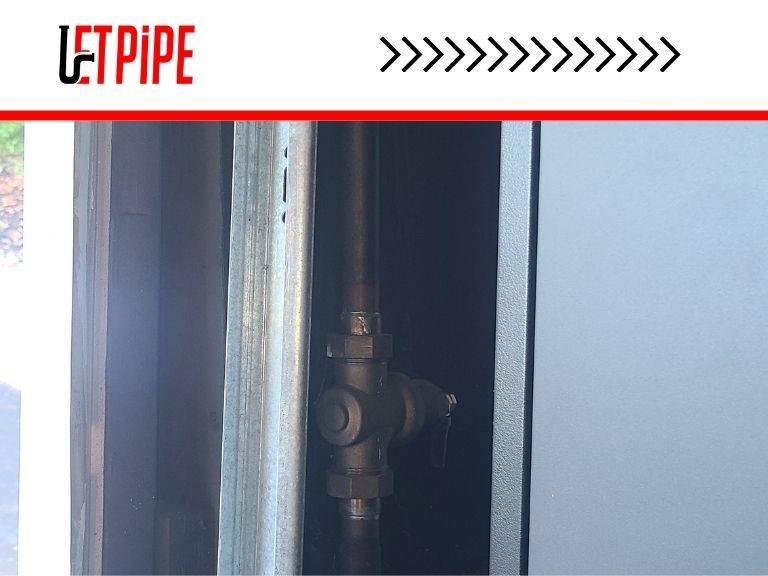
It is a small device, roughly the size of a coffee can, mounted on the gas line right after your meter. When the ground shakes hard enough, it closes on its own. No wrench, no decision, no one standing next to a gas line trying to remember which way the lever turns.
Fall is a sensible time to deal with this. Preparedness campaigns run in September, contractors have not yet hit the winter rush, and permits move faster before the rains start.
How the valve knows
Inside most of these valves is a steel ball resting in a shallow cup, held there by nothing but gravity.
Shaking of a certain intensity rolls the ball out of its seat. It drops and trips a mechanism that cuts the gas to the house. The trigger point is set high enough that a passing truck or a slamming door will not do it, and low enough to react to the kind of quake that damages piping.
There are no batteries. Nothing to charge, nothing to program, nothing to fail quietly in the background. That simplicity is the whole point of the design.
Two different devices, often confused
Ask about earthquake valves and you will hear about two products. They are not the same thing.
A seismic valve, sometimes called a motion-sensitive device, responds to shaking. It shuts off the gas whether or not a pipe has actually broken.
An excess flow valve responds to flow instead. If a line is severed and gas starts rushing through at a rate the system was never designed for, the valve senses that surge and closes. It does nothing during shaking if the piping stays intact.
Both are legitimate, and some local codes accept either one. They protect against slightly different failures, so it is worth knowing which one you are being quoted.
Not sure if your Bay Area home is protected when the next quake hits?
We’ll check your gas line and install the shutoff valve that closes it for you.
Why the gas line is the part that worries people
Water damage from a quake is expensive. Gas is a different category of problem.
Your gas piping is rigid steel bolted to a structure that moves during a quake. Appliances sitting on that same floor do not move with it in the same way. A water heater that shifts even a few inches can pull hard on the connector feeding it. Older homes here often have rigid connections or aging flexible ones that were never designed for that kind of stress.
The result is not usually a dramatic break. It is a small separation at a joint, leaking into a closed garage or crawlspace, with nobody home to smell it.
Shutting off gas to the whole house within seconds removes that scenario entirely.
Does your city require one?
Requirements vary from one city to the next in this region, which is why the answer you get from a neighbor may not apply to your address.
Some Bay Area jurisdictions have adopted ordinances requiring an approved seismic or excess flow device on new construction, on additions and alterations above a set dollar value, or any time a plumbing permit is pulled for gas piping. Milpitas is one example among South Bay cities with rules on the books. A few California cities also tie the requirement to the sale of a property, which is where it tends to surprise people mid-escrow.
Two things are true statewide. The valve has to be a model certified by the Division of the State Architect, and it has to be installed by a contractor licensed in the right classification, following the manufacturer’s instructions.
Your city building department can tell you in one phone call whether a permit and inspection are needed at your address. If you are planning a remodel or a gas appliance change anyway, ask before the work starts rather than after.
Where it goes and who installs it
PG&E does not install these valves and does not service them. That surprises a lot of homeowners who assume it is utility equipment.
The valve belongs on your house piping, downstream of the meter, after the utility’s service tee. Nothing may be attached to the utility side of that point, and the installed valve cannot block access to the meter, the regulator, or the utility shutoff. Most local codes also want it mounted rigidly to the exterior of the building, unless the specific model is listed for another method.
PG&E will shut the gas off for the installation and turn it back on afterward. The plumbing work itself, the permit, and the inspection are handled by your contractor.
This is a C-36 job and worth treating as one. A valve installed on the wrong side of the meter, sized incorrectly, or mounted so it can trip from vibration is worse than no valve at all.
What happens after it trips
The valve stays closed until someone opens it. That is deliberate.
Resetting takes a tool and about a minute, but the reset is not the important part. Before gas goes back into the house, someone needs to confirm there is no leak, and every pilot light and appliance in the house needs to be checked and relit properly. Gas appliances left open when supply returns are exactly the hazard the valve was protecting you from.
Keep the reset instructions where you will actually find them, taped inside the electrical panel door or in the same drawer as the flashlight. Not filed with the closing paperwork.
What the valve does not do
It shuts off gas at the meter. It cannot help with anything downstream of that point.
An interior leak from a corroded pipe, a loose appliance connector, or a stove valve someone bumped will not trigger it. Neither will a slow leak that never produces enough shaking or flow to register.
So a valve is one layer, not a plan. The others are ordinary maintenance. Water heaters need to be strapped correctly at both the upper and lower third of the tank. Flexible appliance connectors have a service life and get brittle with age. Gas piping in older homes should be checked for corrosion where it enters walls, exits the ground, or runs through a damp crawlspace. Our gas line repair page covers the failure points we see most often in South Bay houses.
If you smell gas
None of the above applies in that moment. Leave the building, take everyone with you, and do not touch light switches, appliances, or your phone until you are outside and away from the house. Then call PG&E or the fire department from a safe distance.
Do not go looking for the leak yourself, and do not try to shut the gas off unless you can do it safely on your way out.
A reasonable order of operations
Start by calling your city building department and asking whether a valve is required at your address and whether a permit is needed. That determines everything else.
Then have your gas piping looked at. If there is corrosion or an undersized run somewhere, that is worth knowing before you add a valve to the front of it. A gas line inspection and installation visit covers both the valve and the piping behind it.
While a plumber is there, ask about water heater strapping and connector condition. Those are small line items on the same visit and they address the failure most likely to actually happen in your house.
JetPipe Plumbing is a licensed C-36 contractor working across Sunnyvale, Santa Clara County, and the Peninsula. We install approved seismic and excess flow devices, handle the permit, and coordinate the utility shutoff. Same-day service is available and estimates are free.
Wondering who’s supposed to turn off your gas at 3am during an earthquake?