
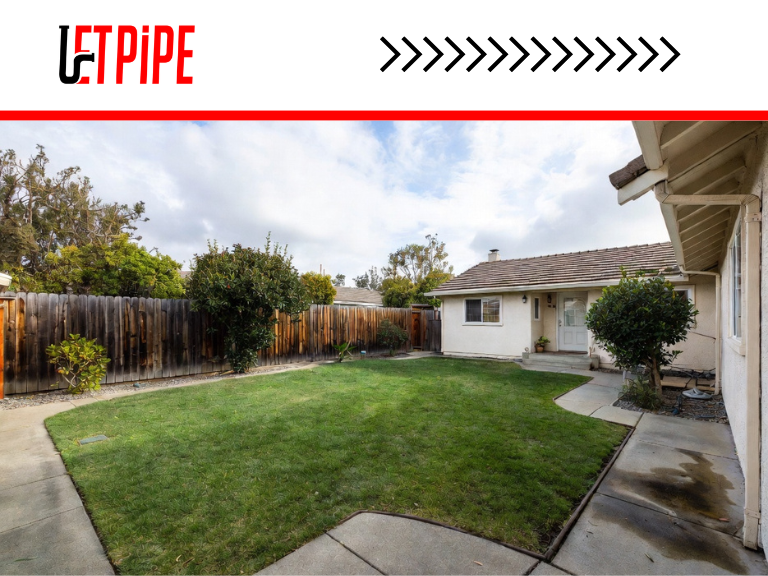
There is a 1962 ranch-style house in Sunnyvale with a concrete slab, an original clay sewer lateral, and a backyard that has looked perfectly fine through every tremor anyone can remember. Loma Prieta in 1989. Napa in 2014. A few dozen smaller shakers since. No visible cracks, no sewage backup, nothing in the water bill that raised a question.
The owner redid the kitchen two years ago. New cabinets, new counters, new faucet. The backyard gets watered twice a week. But four to six feet underground, between the cleanout and the city main, the joints have shifted. There are hairline fractures in the clay. Fine roots from a nearby tree are working their way in through a gap you could barely slide a business card through. Nothing about the yard tells you any of this.
That house is common. Tens of thousands of South Bay homes built between 1950 and 1980 are sitting on aging laterals that have never been inspected after a significant earthquake. Seismic pipe damage is quiet by nature. It accumulates in the dark, and the first visible sign is usually an expensive one. This article covers what earthquakes actually do to sewer and water lines, which symptoms matter, and why waiting for something to go wrong is usually the costliest strategy.
Why Bay Area Pipes Are Especially Vulnerable
Residential plumbing buried under the yard gets almost no attention after an earthquake until something goes wrong. Bay Area pipes face three separate stress sources simultaneously, and each one makes the others worse.
1. Old Pipe Materials Not Built for Ground Movement
Most sewer laterals installed in Sunnyvale, Santa Clara, and Mountain View before 1975 are clay or Orangeburg. Orangeburg is a compressed paper-and-pitch composite that was never meant to last more than 50 years; a lot of it is well past that. Neither material flexes. Both use bell-and-spigot joints, where one pipe section fits into the flared end of the next. The joint holds as long as the soil around it stays put. When the ground shifts, even fractionally, the joint opens.
Cast iron and galvanized steel supply lines from the same period have their own problem: corrosion. Bay Area water is hard — 7 to 19 GPG depending on whether you are on the Cal Water, Valley Water, or East Bay MUD supply. Decades of mineral deposits thin the pipe walls at fittings and threaded connections. A pipe that has lost 30% of its wall thickness does not need a major earthquake to develop a pinhole leak. A 4.5 tremor can be enough to open a fitting that was already close to the edge.
2. Three Active Fault Zones Running Through Residential Areas
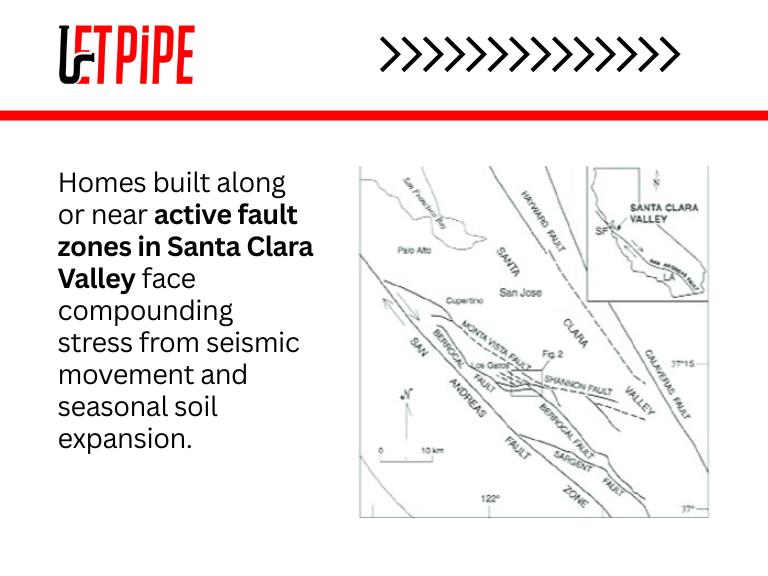
The Hayward Fault runs through the eastern Bay Area and is rated by USGS seismologists as one of the most hazardous active faults in the country. The Calaveras Fault passes through parts of the East Bay and South Bay. The San Andreas runs about 20 miles west of Sunnyvale, but its ground motion reaches the entire valley. None of these fault systems is dormant.
The Bay Area sees several dozen measurable tremors per year. Infrastructure installed in the 1950s and 60s was not built to absorb that kind of ongoing load. The 1989 Loma Prieta earthquake caused an estimated $6 billion in regional infrastructure damage. Homes that have not had a sewer inspection since then have accumulated 35 years of seismic stress with no baseline to compare against.
3. Expansive Clay Soil That Moves Between Earthquakes
Much of the Santa Clara Valley sits on Vertisol clay, the same alluvial soil responsible for the valley’s agricultural productivity. Clay absorbs moisture and swells during wet months. It shrinks and cracks in summer. That seasonal expansion and contraction applies constant stress to buried pipes even when the ground is not shaking.
Earthquakes add to what the soil is already doing. A joint that has been ratcheted open a fraction of a millimeter by three wet seasons has less tolerance for seismic loading than a fresh installation. The tremor does not have to be large. It only needs to add the final increment that pushes a stressed joint past its limit.
What Actually Breaks and How
Post-earthquake pipe damage usually does not announce itself. There is no sudden rupture, no flooded yard, nothing that triggers an immediate call. The process is slow and underground, and understanding the mechanics of each failure type explains why most of it goes unnoticed.
Sewer Laterals (Clay and Orangeburg)
A clay lateral under a slab is most vulnerable at its joints, which occur roughly every 3 to 6 feet. When the ground shifts sideways during a tremor, the bell-and-spigot joint does not crack — it separates. A gap of 2 to 5 mm is all it takes. Groundwater can now enter the pipe, and fine root tendrils will find the moisture within one or two growing seasons. Roots do not stop once they are in. A root that establishes itself in a joint gap will thicken each year until it causes a mechanical failure.
A lateral with open joints drains normally. The homeowner has no reason to suspect anything. By the time slow drains or a sewage backup appear, the root mass inside the pipe can be significant, and the affected section is often more than a single joint.
Water Supply Lines (Galvanized Steel and Copper)
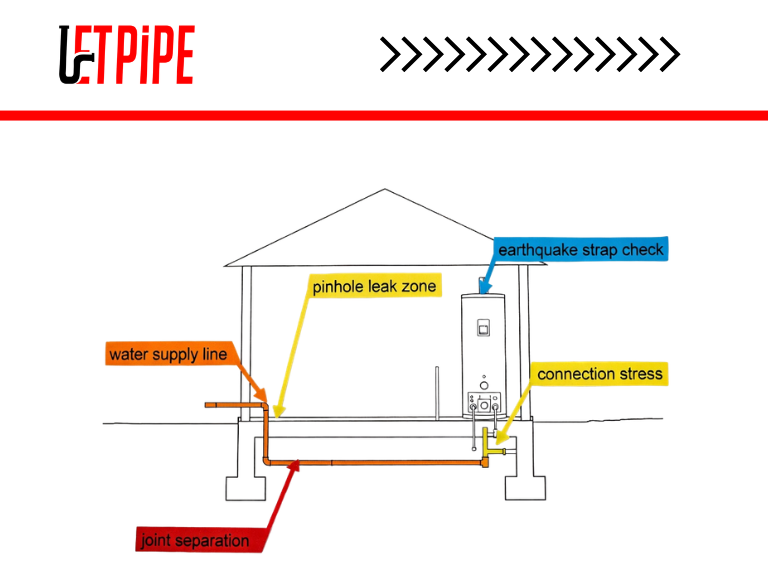
Galvanized steel supply lines fail at fittings, where the wall is thinnest and mineral deposits are heaviest. A seismic event sends a pressure impulse through the entire supply system simultaneously. For a fitting that has been corroding for 40 years in hard South Bay water, that impulse can open a pinhole leak that runs inside a wall cavity for weeks before any staining appears.
Copper supply lines are more resistant, but not immune. Solder joints in homes built before the mid-1980s were typically lead-based and are prone to pitting as the lead leaches out. Stress corrosion at those joints is a real failure mode after seismic loading.
Gas Lines
The highest-risk points on a gas line after a tremor are the connection points: the flexible connector between the rigid supply and an appliance, and the threaded connection at the meter or in-wall drop. Flexible connectors manufactured before 1973 predate the switch to corrugated stainless steel and are far more susceptible to fatigue failure. Even minor structural movement during a tremor can stress an aging connector past what it was designed to handle.
Water Heaters
An unstrapped water heater is a 40 to 50 gallon tank balanced on legs, connected to both a gas supply and a water line. If it shifts or falls during a seismic event, the gas connection can separate. California has required seismic strapping on water heaters since 1991, but the law applies at installation. A tank that was strapped 25 years ago may have corroded hardware, a strap that was never tightened properly, or one that was swapped out by a previous owner without a permit inspection. We see all three regularly. Compliance on paper does not mean the strap will hold.
| On the Timeline of Failure Seismic pipe damage rarely shows up right after the shaking stops. East Bay MUD tracks pipe break rates across its service area, and the pattern after significant earthquakes is consistent: failures peak not in the days following a tremor but weeks and months later. Joints weakened by the initial event continue to degrade under normal operating pressure and seasonal soil movement. Waiting for a visible symptom means waiting until the damage is already well advanced. |
Know What’s Under Your Yard Before It Becomes a Problem
One 60-minute inspection shows exactly what decades of seismic stress have done to your lateral.
What to Check in the First 72 Hours After a Quake
Most seismic pipe damage gives no signal in the first hours after a tremor. That is exactly when a walkthrough matters, not because you expect to find something dramatic, but because the problems that become expensive later are often visible as small, easy-to-miss signs right after the event. After any tremor you felt noticeably, or a reported event above 4.0 nearby, go through this list before the day is out.
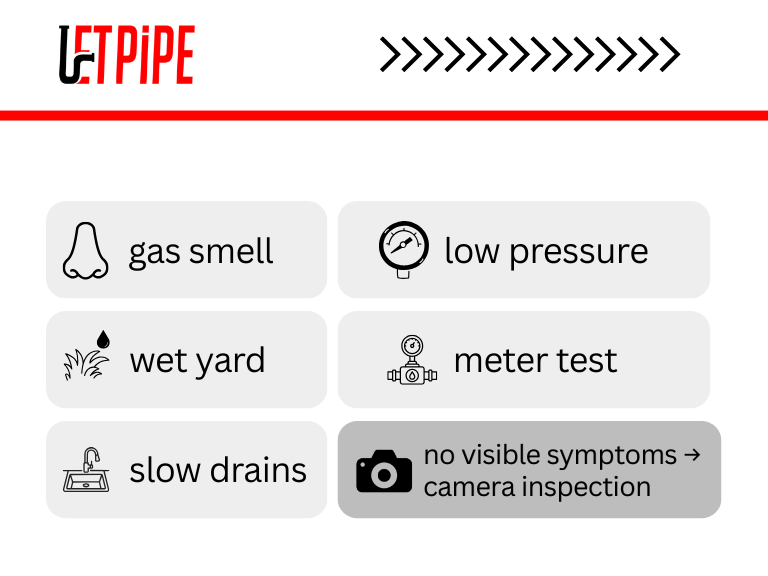
| Sulfur or rotten-egg smell near gas appliances or anywhere indoors Leave the building without using light switches or any electronics. Call PG&E from outside at 1-800-743-5000. Treat it as a gas leak until you have confirmation otherwise. |
| Wet patches on the lawn or at the foundation with no obvious source If there has been no rain and irrigation is off, surface moisture near the foundation or along the lateral path often means a sewer joint has separated or a water line is leaking underground. Larger wet areas generally mean a larger breach. |
| Multiple drains slowing down at the same time A single slow fixture is usually a local clog. When the kitchen sink, shower, and tub all lose drainage at the same time, the blockage is downstream of where those lines converge — typically in the sewer lateral. |
| Lower water pressure than usual with no city-side explanation If your neighbors have normal pressure and the city has not posted a notice, reduced household pressure can point to a supply line break or a joint separation somewhere in the system. |
| Water meter reading that changes when nothing is running Write down the meter reading, then leave all fixtures off for two hours — no toilets, no irrigation, no appliances. Check the meter again. Any change means water is moving somewhere it should not be. |
| Water heater shifted, tilted, or with a kinked connector An unstrapped or improperly strapped water heater can move during a tremor and stress the gas connection without breaking it outright. Check that the tank is upright, the flexible gas connector is not kinked or pulled, and the straps are still tight. If anything looks off, turn off the gas supply at the unit and call before using it. |
| No symptoms at all in a pre-1980 home Sewer lateral damage from seismic events often produces no visible signs until root intrusion or soil subsidence becomes severe. For homes built before 1980 with clay or Orangeburg laterals that have not been inspected after a significant tremor, the absence of symptoms is not a reliable indicator of pipe condition. |
Sewer Camera Inspection After a Significant Quake
A sewer camera inspection is not something you call for when drains are backing up. For a home built in the 1960s in Sunnyvale or Santa Clara with an uninspected clay lateral, it is the only way to get an actual picture of what the pipe looks like after 35 years of accumulated seismic load. There is no other method that gives you this information without digging.
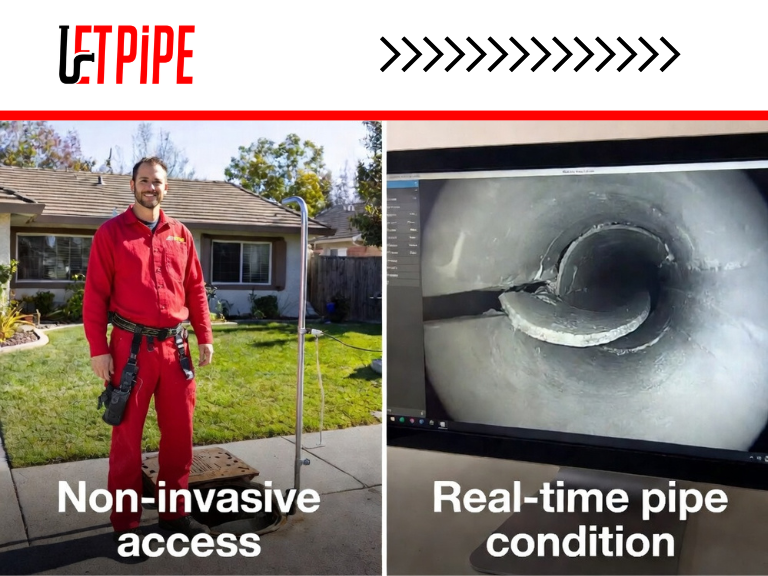
The technician accesses the line through a cleanout, a capped fitting at the foundation or near the street, and runs a waterproof camera through the lateral. The camera sends back live footage showing the condition of every joint along the line — cracks, displacement, root intrusion, and offset sections. No digging, no disruption to the yard. A standard single-family lateral typically takes 45 to 60 minutes.
What the camera shows determines the next step:
- Joints intact, no root intrusion, no displacement — documented baseline, no action needed.
- Minor joint separation with no root growth yet — schedule a follow-up inspection in 12 months.
- Root intrusion or confirmed displacement — hydrojetting clears the line, then evaluation for repair based on the extent of damage.
Seismic Gas Shut-Off Valves
One thing that often gets skipped in post-earthquake checklists: the gas shut-off valve. A seismic gas valve cuts the supply automatically when it detects ground acceleration above a set threshold. For Bay Area homes, it is a standard installation, but a lot of older houses either never had one added or have a valve that has not been tested in years. If the next significant event triggers it and it does not close, the valve has not done its job.
If your home does not have one, or if it has not been tested in more than five years, that is worth addressing before the next significant event. JetPipe installs and checks seismic gas shut-off valves as part of gas line service.

Post-Quake Plumbing Inspection in Sunnyvale
In roughly one out of every three older South Bay homes we inspect after a seismic event, we find joint separation or early root intrusion the homeowner had no indication of. By the time there are symptoms, the repair is usually more involved than it needed to be.
If your home was built before 1980 in Sunnyvale, Santa Clara, Mountain View, or the broader South Bay and the lateral has not been inspected since the last significant tremor, call us at (650) 495-4570. We handle sewer camera inspections, water and gas line diagnostics, and seismic shut-off valve checks across the South Bay and Peninsula. Same-day availability. Free diagnostics. C-36 License #1139033.
| ⚠ Safety Warning If you smell gas or suspect a gas leak, leave the building immediately. Do not operate any electrical switches, open flames, or electronics. Call PG&E at 1-800-743-5000 from outside the building. Call 911 if you cannot exit safely. Do not re-enter until cleared by emergency services. |