
A licensed plumber’s guide to what utility infrastructure checks catch homeowners off guard and how to get ahead of them before they stall your project.
The Permit Stop Nobody Warned You About
A homeowner in Sunnyvale spent six months working with an architect on an ADU behind their ranch house. The design was solid. The setbacks were fine. The zoning worked. They submitted their permit application and waited.
The stop came from the Building Department. Not zoning. Not the setbacks. The sewer lateral.
The city needed documentation that the existing underground pipe connecting the house to the city sewer main could handle a second dwelling unit. Nobody — not the architect, not the contractor who gave the initial estimate, not the real estate agent who sold them the house three years ago — had brought it up.
This is not an unusual story. Utility capacity issues, including sewer, rank among the most common reasons for permit delays on ADU projects in the Bay Area. The problem isn’t complicated, but it’s invisible until the city asks about it, which is usually after several months of design work and several thousand dollars in fees.
This article covers what the sewer lateral is, when cities require an assessment, what that assessment involves, and what your options are if the lateral turns out to be a problem. The goal is to give you this information before you’re in the middle of a plan check, not during it.
What Is a Sewer Lateral and Why It Matters for Your ADU
The sewer lateral is the pipe that runs from your house to the city’s sewer main, which is typically located under the street. It carries all the wastewater from your home: toilets, sinks, showers, and laundry.
Here’s the part most homeowners don’t know: that pipe is yours. From the house to the city connection point, the lateral runs under your property and is your responsibility to maintain, repair, and replace if needed. The city owns the main on the street. The line under your yard is on you.
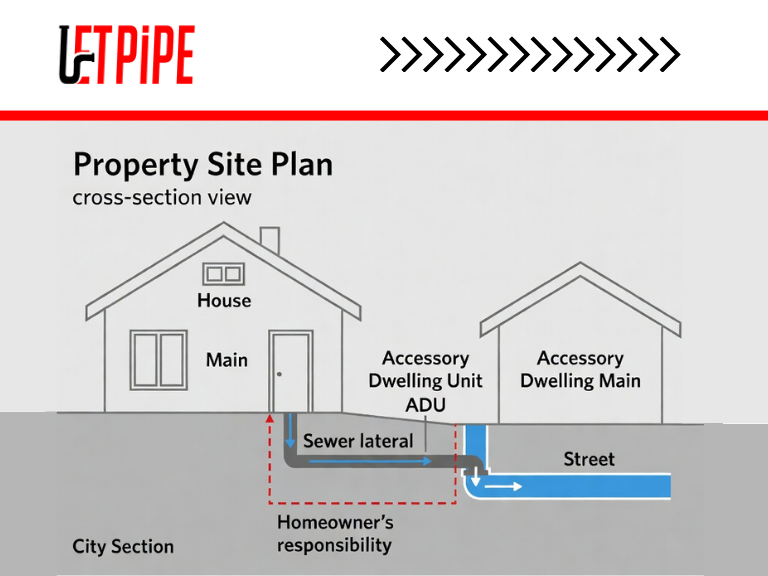
When you add an ADU, you’re adding a second kitchen, a second bathroom, and possibly a laundry connection — another full dwelling unit generating wastewater through the same pipe. The city’s permitting process requires confirmation that the existing lateral can handle that additional load before it will approve the project. If the lateral is old, too narrow, damaged, or failing, the permit gets held until the issue is resolved.
The lateral isn’t a formality. It’s the physical infrastructure that has to support what you’re building on top of it.
When Cities in the Bay Area Require a Sewer Assessment
Not every project triggers an automatic sewer lateral review, but ADU projects come very close. Here are the specific conditions that typically require an assessment before a permit can move forward:
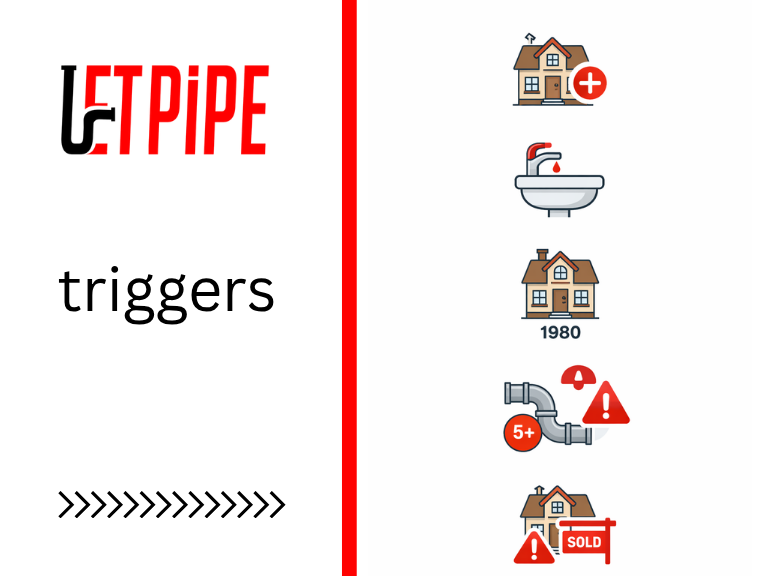
- New detached ADU construction. Adding a separate dwelling unit is the clearest trigger. Most Bay Area jurisdictions require confirmation of sewer lateral adequacy as part of the ADU permit process.
- Adding a kitchen or bathroom to an existing structure. New plumbing fixtures increase the load on the lateral. If a converted garage or basement ADU adds a full bathroom and kitchen, expect this to come up.
- Home built before 1980. Older homes are more likely to have clay or cast iron laterals that have been in the ground for 40 to 70 years. These materials degrade over time, crack, shift at joints, and get invaded by tree roots. Many cities require inspection as a condition of permit approval for properties this age.
- Lateral not tested or inspected in the past five years or more. If there’s no documentation of the pipe’s condition, the city has no basis to assume it’s adequate.
- Property sold within the last several years without a sewer inspection. Some Bay Area cities require a sewer lateral test at close of escrow. If your home sold without one, there may be no condition data on the pipe at all.
The last two items tend to catch homeowners off guard. If you’ve owned the house for a while and never thought about the sewer lateral, there’s a good chance no one has looked at it since it was installed.
Can Your Lateral Actually Handle Two Units?
The question isn’t just whether the pipe is cracked or clogged. It’s whether the pipe can handle the combined peak load from two occupied dwelling units without backing up.
Sewer laterals are sized at the time of installation based on the anticipated load from the structure. In homes built in the 1950s through 1970s in Sunnyvale, Mountain View, Santa Clara, and surrounding cities, a 4-inch diameter lateral is common. That’s workable for a single-family home. For two units running simultaneously, you’re at the edge of what a 4-inch pipe can reliably move.
Diameter alone isn’t the only factor. Slope matters. A lateral with inadequate slope doesn’t move waste fast enough to prevent solids from settling and accumulating. A pipe that’s slightly undersized and also running at a shallow grade is a slow-motion backup waiting to happen once the load increases.
The city can’t verify any of this from a permit application. The only way to get a definitive answer on both pipe condition and capacity is a camera inspection. Without that inspection, there’s nothing for the city to approve of.
Know What’s Under Your Yard Before It Becomes a Problem
Schedule a Sewer Lateral Inspection Before You Start Designing
What a Sewer Lateral Inspection Actually Involves
The inspection process is less invasive than most homeowners expect. Many people assume it means digging up the yard. It doesn’t, at least not at the inspection stage.
Camera Inspection
A camera inspection is exactly what it sounds like. A plumber accesses the lateral through the cleanout, which is a capped access point typically located at the foundation of the house or in the yard. The camera is fed through the cleanout and travels the full length of the lateral from the house to the city main.
The process takes one to two hours. The camera transmits a live video feed, and the footage is recorded. The resulting report documents everything the camera captures: cracks, joint displacement, root intrusion, deformation, soft spots in the pipe wall, and the approximate slope. You get a clear picture of what’s actually down there.
Pressure Test
A pressure test is a separate procedure, required by some jurisdictions as part of the sewer lateral compliance process. The lateral is plugged at both ends, air or water pressure is applied at 4 psi, and the pipe needs to hold at least 3.5 psi for five minutes. If it doesn’t, there’s a leak somewhere in the line, and repair or replacement is required before the permit moves forward.
It’s significantly better to know about a lateral problem before submitting a permit application than to discover it during the plan check. A pre-permit inspection is a small step compared with a project delay of three to six months while you arrange repairs.
If the Lateral Fails: What Your Options Are
A failed inspection doesn’t kill the ADU project. It tells you what needs to happen before the permit can move forward. The right path depends on what the inspection found.
Option 1: Targeted Repair
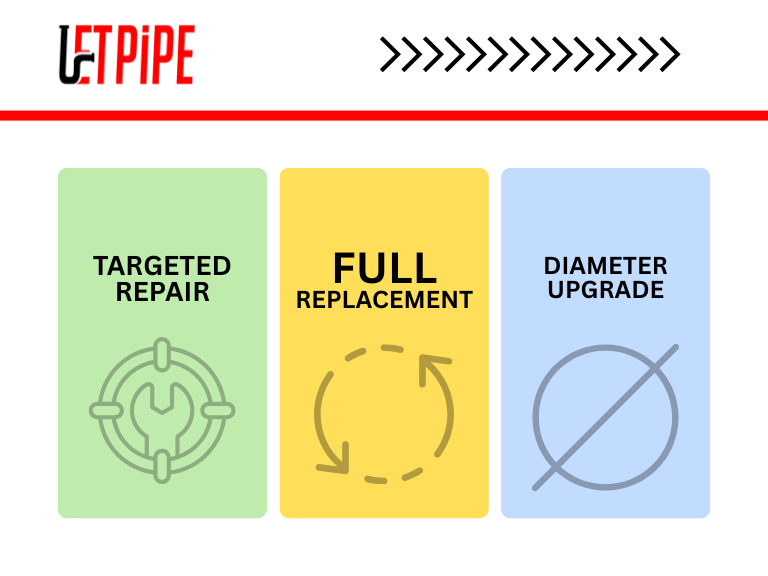
If the camera shows a single localized problem — one cracked section, one displaced joint — a targeted repair addresses the specific failure without replacing the entire pipe. This is the lowest-cost path and works well when the rest of the lateral is in reasonable condition.
Best for: isolated damage in an otherwise sound lateral. Relative cost: low.
Option 2: Full Lateral Replacement
If the pipe is in poor overall condition — Orangeburg pipe (a fiber-based material common in mid-century construction that essentially disintegrates over time), severely corroded cast iron, or widespread cracking along multiple sections — a targeted repair won’t solve the problem. Full replacement runs from the house to the connection at the city main and is an open-cut excavation project.
It’s the most disruptive and most expensive option, but it resolves the question permanently. After replacement, the lateral is new, and you’ll have documentation of its condition and capacity.
Best for: laterals in poor overall condition. Relative cost: higher.
Option 3: Diameter Upgrade
If the camera shows the pipe is physically intact but the diameter isn’t sufficient for two units, the solution is replacement with a larger pipe. The existing lateral doesn’t need to be failing — it just needs to be bigger. This is common with the 4-inch laterals installed in 1950s and 60s homes where two-unit capacity wasn’t the design consideration.
Best for: laterals that are sound but undersized. Relative cost: mid-range, depends on length and access.
All three options are solvable. The problem isn’t that sewer lateral issues end ADU projects — they rarely do. The problem is discovering them in the middle of the permitting process instead of before it started.
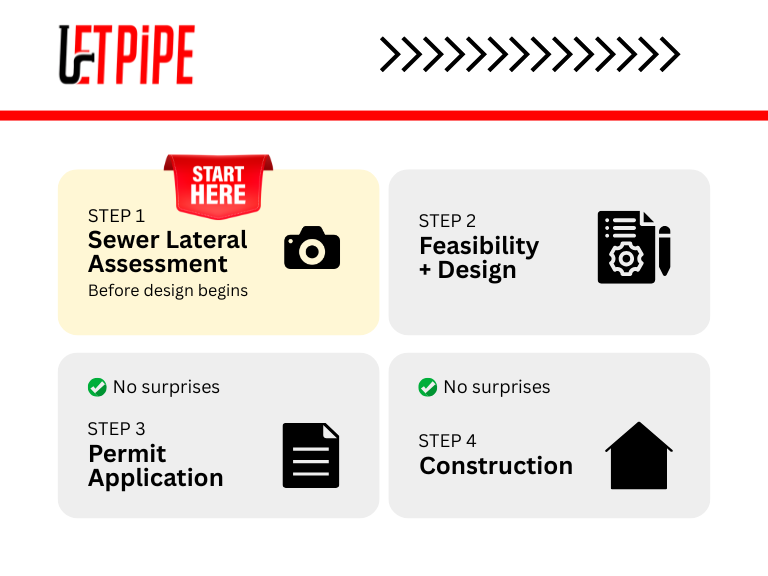
The Right Sequence: Assess Before You Design
Most homeowners start an ADU project with the architect. They work on design, floor plans, and elevations for months, then submit for permits and find out there’s a sewer lateral problem. At that point, they’re looking at repair timelines, revised budgets, and potentially redesigning portions of the project depending on where the lateral replacement work needs to happen.
The better sequence is this: get a sewer lateral camera inspection before you begin design or, at minimum, before you submit a permit application.
The inspection takes one to two hours. The report gives you documentation you’ll need for the permit anyway. If the lateral is in good condition, you move forward knowing the underground infrastructure isn’t going to be a problem. If there’s an issue, you know about it while the project is still flexible enough to absorb it.
There’s also a cost item worth accounting for separately: the sewer connection fee for an ADU. Cities typically calculate this fee based on square footage proportional to a baseline (often around 1,200 sq ft for a single-family home). For a 600 sq ft ADU, the fee is typically around half the standard connection rate. This varies by city, but it’s a real line item and worth getting from your local public works department before you finalize the project budget.
Before You Design Your ADU, Check What’s Under the Ground
If you’re planning an ADU in Sunnyvale, Santa Clara, Mountain View, Palo Alto, or surrounding cities, a sewer lateral camera inspection is the first practical step. It’s not a bureaucratic requirement, but it lets you know what you’re really working with before you spend months and a lot of money on a design that might not work.
JetPipe Plumbing performs camera inspections on sewer laterals across the South Bay and Peninsula. We assess pipe condition, evaluate capacity for the additional load an ADU creates, and provide a written report you can submit with your permit application. If there’s a problem, we tell you exactly what it is and what it takes to fix it.
To schedule a sewer lateral inspection or ask about what the process looks like for your specific property, call us at (650) 495-4570. We’re licensed plumbers, so we’ll tell you exactly what your lateral needs.